Tuesday, November 15, 2011

John Gunderson ~ Mayor of the Month ~ November 2011


John Olaf Gunderson


John Olaf Gunderson was born August 20, 1875 in Mount Pleasant (Sanpete County), Utah to Erick and Carolina Cecilia Johnson Gunderson.  He was the tenth child born to them, out of eleven.  Both his mother and father were born in Risor, Norway, where his father was a carpenter and shipbuilder.  Caroline, his mother, crossed the plains to settle in Utah.  She was Erick’s second wife and they were married on October 12, 1857 about five weeks after she’d arrived in Utah.

His siblings included:
Elizabeth, born September 6, 1858.  She died in December of 1861. 
Mary, born February 17, 1860.  She died in April of 1861. 
Erick was born February 18, 1861,
Johann Henry, born April 15, 1863
Gunder Anthon, born October 15, 1865
Caroline, born December 5, 1867.  She died in October of 1868
Andreas Lauritz, born November 4, 1869
Jens (James), born September 26, 1871
Carlos, born July 5, 1873
Nephi, born November 1878

John Olaf married Marie (Rhea) Brotherson on September 18, 1898 in Mt. Pleasant, Utah.  They were the parents of six sons and one daughter: John Douglas, Shirley Hans, Glen B., Reed, Shila Rhea, Ivan Anthon, and Keith Henry.

Grandpa Gunderson was quite a prominent man and rated a full-page mention in Volume 3 of UTAH SINCE STATEHOOD.  Based on information in this write-up, we know that this book was published sometime between 1917 and 1920.  In it is included quite a bit of his genealogy:

“John Gunderson, residing in Mount Pleasant, is interested in farming, in the sheep industry and in stock raising and he has wisely and carefully conducted his affairs, so that he has won a substantial measure of success.  He was born in Mount Pleasant August 20, 1875, a son of Erick and Caroline (Olsen) Gunderson, both of who were natives of Norway, the father having been born on the 27th of August 1830, while the mother’s birth occurred June 3, 1837.  Each crossed the Atlantic in early life and came to Utah with different handcart companies.  It was in 1855 that Erick Gunderson made the trip and first settled in Salt Lake but the following year removed to Spanish Fork and in 1859 was called upon to assist in settling Mount Pleasant.  He was therefore one of the pioneers, his name being engraved on the monument which was erected in 1909 in honor of the first settlers.  He also participated in the Indian wars, aiding in defending the white people against the attacks of the red men (sic).  He was a carpenter by trade and was in charge of the erection of the Mormon church buildings in Mount Pleasant, together with public buildings, and as a finisher did special work on three of the four temples at Salt Lake, Manti and St. George.  It was also in 1855 that Mrs. Caroline Gunderson came to Utah.  She was then a girl of sixteen years and she, too, traveled with a handcart company in charge of Captain Kanute Peterson, who was afterward president of the Sanpete Stake.  She pulled a handcart and her mother, who was blind, aided by pushing the cart.  The trip was a very trying one and she, as well as her husband, experienced all of the hardships and privations of pioneer life.  She was married in Salt Lake City in 1857 by President Young and by her marriage she became mother of the following named: Lurine, who was born September 6, 1858, and died December 28, 1861, at Spanish Fork; Marie Elizabeth, who was born February 17, 1861, and died April 21, 1862; Erick, who was born September 18, 1862, and married Cecilia Francen, by whom he has five children; Henry Olaf, who was born April 25, 1863, and died in Aspen, Colorado, November 23, 1885; Gunner Antone, who was born October 15, 1865, and wedded Amanda Beckstrom, by whom he had four children, two of who are deceased; Caroline Cecelia, who was born November 5, 1867, and died October 12, 1868; Andreas Lars, who was born November 4, 1869, and married Sadie Nelson, their children being seven in number; J. E., who was born September 26, 1871, and married Clara Gee, who died leaving five children; Carlos, who was born July 15, 1873, and married Capitola Groesbeck, by whom he had eight children, of whom one is deceased; John, of this review; and Nephi, who was born November 23, 1888, and married Marie Hanson.  They are parents of six children who are living and have also lost one child.

“Reared under the parental roof, John Gunderson pursued his education in the public schools of Mount Pleasant and after his textbooks were put aside took up the occupation of farming, which he followed for several years.  He then extended the scope of his activities to include sheep raising and stock raising and has remained active along those lines to the present time.  He is today one of the successful agriculturists and sheep and stock raisers of this section of the state.  He specializes in sheep and he has several ranges, affording valuable pasturage for his flocks.  He is also the owner of several good farms and he has made investment in stock in the Peoples Sugar Company of Moroni, Utah and various other safe investments.  He is a man of sound business judgment and enterprise and his success is the direct result of well-defined labor, intelligently directed.

“On the 18th of October, 1898, in Mount Pleasant, Mr. Gunderson was married to Rhea Brotherson, a daughter of Hans and Rakie (Jensen) Brotherson, who were natives of Denmark and at an early age came to Utah, crossing the plains with ox teams.  The father followed farming and stock raising until his death, which occurred in Mount Pleasant in 1900.  The mother is still living.  They had fourteen children who survive and one who died at the age of forty-three years.  Twelve of the fourteen children are married.  To Mr. and Mrs. John Gunderson of this review have been born six children, namely: John Douglas, who was born January 18, 1899; Shirley Hans, born May 8, 1901; Glen B., March 21, 1903; Reed, February 18, 1908; Shila B, April 12, 1910; and Ivan A., January 27, 1912.  The children are all natives of Mount Pleasant.

“Mr. Gunderson and his family are members of the Church of Jesus Christ of Latter-day Saints.  In politics he is a republican, interested in the success of the party and doing all in his power to promote its growth and secure the adoption of its principles.  In the fall of 1916 he was elected a member of the city council and entered upon the duties of his office January 1, 1917, for a four years’ term.  He is a very progressive man, but modest and unassuming, his well spent life, however finding expression in his valuable property and good investments.”

Grandpa was not too active in the Church of Jesus Christ of Latter-day Saints, but in November 1937, he was asked to be on the building committee and he supervised the entire construction of the beautiful edifice, the Mount Pleasant South Ward Chapel.

Dave tells the story of working construction in Ogden when he was still in school.  He was working with an older guy, who asked him where he came from.  He told him he was from Ogden.  The guy asked, “Where’s your family from?”  Dave said his Dad’s family was from Mount Pleasant.  The guy said, “Are you related to that S.O.B. John Gunderson?  He was just incorrigible!”  He went on to tell the story of going into the local pool hall in Mount Pleasant on a hot day to play pool and have a beer or two.  Grandpa Gunderson would come in and ask, “Any of you guys got jobs?”  Of course, they didn’t, so he would commandeer them into working on the new church building.  He recalled putting insulation in the attic for three days.  Grandpa came around and supervised.  “You’d think he was paying you!”  When Dave questioned him about how he felt about doing the work and if he was sorry about doing it, he responded, “You’re just like him.”

Even though it was the custom in those days to irrigate the lawns, Grandpa felt they ought to have a sprinkling system at the church, but there was no money for it.  So he got the men who were working in the CCC (Civilian Conservation Corps) to dig the trenches for the sprinkling system pipes.  When they finished digging, he said, “Didn’t you bring the pipe?”  So they went back to the CCC camp and got pipe and installed it.  They may have even provided the sprinklers.

Grandpa brought a new level of awareness in the community.  He built a youth room in the chapel where kids could go to hang out, rather than hang out at the pool hall.  Grandpa didn’t like sitting on pews when he attended church, so he arranged for the chapel to be fitted with theater-style, cushioned seats.  Bishop LeGrande Richards (later an Apostle) of Salt Lake City told Grandpa, “We don’t build churches like that in Salt Lake City.”  Grandpa said, “Neither do we; we build them in Mount Pleasant.”

He did the groundwork for the building of the swimming pool near North Sanpete High School.  He was instrumental in securing the new hospital for Mount Pleasant and North Sanpete.  He was active in civic affairs, serving as a City Councilman, County Commissioner, and District Republican Chairman.  He was mayor of Mount Pleasant for three consecutive terms. 

Grandpa resigned as Mayor in April of 1947, due to some disagreements with others in the community regarding obtaining a hospital for Mount. Pleasant.  As there was some discussion as to his service as Mayor, he wrote an open letter to the community that appeared in the local paper on April 18, 1947 outlining some of his accomplishments.  He explained that upon his election he had the satisfaction of bringing the City’s financial difficulties out of an extremely bad situation.  He secured money to pay the debt on the Armory. 

During that period he completed the purchase from the U. S. Forest Service of a mountain lodge formerly used as a recreation center for a CCC camp.  He made arrangements to lease surrounding area from the forest service to be used for city recreational purposes and Boy Scout activities.  This lodge was located eight miles east of Fairview on the Cottonwood Canyon road near the Beaver dams and Gooseberry reservoir.  He said, “Among other things I had pleasure in doing was to get the Boy Scout Cabin in Gooseberry for a song, and I sang it myself.  Then I gave it to the City of Mount Pleasant.”

In his open letter, he outlined the number of places the City had rented at very low rates, and how he had raised those rents to more realistic rates so that there was good revenue coming to the City for those offices.  He managed to get roadwork completed at very low prices.

When Mount Pleasant was flooded, he was able to obtain assistance immediately to dig the town out.  The cost of the cleanup work amounted to $62,000, and he was able to obtain that work without cost to Mount Pleasant City.  He then entered into an agreement with both federal and state governments to protect Mount Pleasant from future disasters of this kind, which included a flood dam as well as a change in control of grazing for future protection.

He felt that one of his fondest hopes, the securing of a hospital for Mount Pleasant, had been accomplished.  He concluded the letter by saying, “I am pleased to have done so much for Mount Pleasant in spite of the efforts of my enemies to hinder me.”

The granddaughter of one of Grandpa’s brothers (Gunder Anthon Gunderson) wrote a story about him in 1947.  Her name is Lois Gunderson Porter.  Her view of Grandpa is quite interesting.  Here is her story on The Mayor of the Town” – John Gunderson:

“The mayor of the small town in which we lived, is a congenial, stout, jolly fellow who has made a hit with almost everyone.  His hobby is being Mayor, and he devotes all his time to doing a good job of it.  He will especially be remembered by the crowd of kids who are my age because one of the first community projects he completed after taking office as mayor was building a beautiful swimming pool.  The east windows of our high school building looked out over the recreation grounds where the pool was being built.  Each day the students watched its progress, from the time the digging began until the last day of school, when it was nearly completed.  The dedication was a day of celebration, and from then until the pool closed in the fall some of the youngsters did not miss a day in the cool water.

“The Mayor’s business connections and many friends, together with his own initiative and persistence, have made it possible for him to accomplish many of his aims for the benefit of the citizens.  Through his efforts a beautiful county hospital is to be built in the town, where people from surrounding communities may use its services.  The Mayor’s father and six brothers were all carpenters; consequently he takes great pride in supervising all building work.  He is also my father’s uncle – so we called him ‘Uncle John.’

“Several years ago when the South Ward chapel was destroyed by fire, this energetic man who was later appointed Mayor, was chosen to take charge of building a new church.  It took a great deal of work selling ‘Sunday eggs’ and much sacrifice by the whole community to build the beautiful building they now have, but it is one of the most attractive in the state.  He insisted on soft movie-theater type seats because he wanted everyone to be comfortable as well as himself.  This was something that was very new.

John Gunderson (second from the left) at the dedication
of the new South Ward L.D.S. Churh

“The Mayor is especially enthusiastic about the out-of-doors and takes a great pride in his own yard and garden spot.  In the flower boxes of the church and city hall he plants beautiful double flowering petunias, which bloom all summer and until the frost takes them in the fall.  His family lot in the cemetery shows that it has special care, and on Decoration Day it is always a mass of blooming perennials.  He is also interested in animals and birds.  Last summer he told us he had a nest of woodpeckers in a tree outside his kitchen window and he wanted my sister and me to come up and see them.  We found a pair of woodpeckers flying here and there gathering food for their young, but were in no mood to receive guests.  The nest was a hole in a tree with the entrance about two and one-half inches wide.  The Mayor’s wife said they had watched the birds every morning making their next and preparing for the young.

“Occasionally Uncle John came to see us and usually accepted our invitation to stay for dinner.  We like to joke with him about his telling us there was nothing he could not eat, but we soon found out he ate everything he liked, but there were a lot of things he did not like.   I will never forget the philosophy he often used, ‘Eat the best first and you will always have the best left.’  This bit of humor has stayed with me and I have found it to be true.”

He was chairman of the Second World War Bond Drive—being the first one to buy a bond.  He won national and state recognition for Mount Pleasant being the first city to reach its goal in the nation.  He won a trip to Washington, DC and received a certificate from the United States Treasury Department which read:  “For patriotic cooperation rendered on behalf of the War Finance Program this citation is awarded to John Gunderson.  Given under my hand and seal on June 30, 1945.”  It was signed by Henry Morgenthau, Jr., Secretary of the Treasury, and Chas. L. Smith, State Chairman.

He was active in the Municipal League for many years and served as Vice President. He was also a member of the Sons of the Utah Pioneers and accompanied them on their centennial trek from Nauvoo to Salt Lake City when he was 71 years of age.  He wrote this about his trip:

“I have been grateful and thankful for every minute I spent on the recent trek to Nauvoo and intermediate points.  As we journeyed across the great plains my mind went back to my parents who crossed those wide stretches in that early day.  It renewed my faith to visit all the old landmarks of Mormonism, so I am thankful that I have lived to have that experience.

“My mind also turned to the pioneers and my feelings are expressed in the following:

            “Since first the pioneers began
            To make and build the West for man,
We count the years, one hundred o’er,
And ask where folks have given more,
Where standards have been higher set,
Where truth more earnest welcome met.
Where we find we men and mates who wrought
For grander prizes than they sought?
Let’s doff our hats and bow the head
To those who still life’s pathways tread,
And bless the souls who paved the way
For what is ours this happy day,
And keep in memory fore’er
The meaning of their coming here.”

John Olaf was engaged in the sheep business and served as the State Sheep Inspector.  He ran the sheep on the deserts of Western Utah and Eastern Nevada in the winters and on the public domain in the mountains by Scofield and Price in the summers.

There are a lot of stories about old Jeff – a one-man mule that Grandpa had.  He was sure-footed and loyal to Grandpa.  At night the herders would put hobbles on the horses and mules, and bells so they could hear them.   Grandpa was afraid that a mountain lion might come during the night and get a hobbled horse, although Jeff could run with the hobbles on.  The drovers would hear the bells and get up to protect them.

Then Jeff would go up into the trees and hide from the drovers; he knew the bell sound would lead them to him, so he would stand perfectly still.  The drovers would come back and tell Grandpa that they couldn’t find Jeff.

Grandpa would go out and holler, “Jeff, time to come in now.”  Jeff would come for Grandpa, but not the drovers.

Grandpa Gunderson used to tell his kids about Indians coming to kidnap the white kids and they all had quite a fear of being kidnapped by the local Indians.  In order to get the kids up in the morning, he would come running up the stairs, shouting, "The Indians are coming, the Indians are coming."  They’re at Charlie’s house now.”  Naturally, the kids were up and out of bed in a hurry.

One memory of Grandpa Gunderson was that, among other much more lovable traits, he was a vain man – although he didn’t seem like that when we were children.  We suppose it’s the stories that we’ve heard over the years that make us realize how he was. He always wore shoes that were the latest style, but he always complained about his feet hurting.  When he went to get a new pair of shoes at the store that our Uncle Shy worked at, he insisted on a size 7.  Uncle Shy realized, of course, that the reason Grandpa’s feet hurt so much was that he was wearing the wrong size shoe.  He didn’t tell Grandpa, but he sold him a larger size.  For days Grandpa went on about how great these shoes were and how his feet didn’t hurt.  When Uncle Shy admitted that the shoes were the right size, instead of the size 7’s Grandpa thought they were, Grandpa had a fit and refused to wear them.  “I wear a size 7!”

Because of that story, it is even funnier to hear this one.  Doug told us that once he needed some new shoes, but the size they had were not his size.  Grandpa let him get the shoes, knowing that Doug’s feet would hurt, but also that Shy could wear the shoes.  Doug wore them until he could hardly walk because his feet hurt so badly.  Grandpa said, “Fit your feet, even if you have to wait for the right fit.”  What a hoot!

We remember another time when some of the Gunderson relatives were at Doug’s home for Thanksgiving dinner; Grandpa was taking a nap on the couch.  His snoring was the subject of much snickering among the children.  Our Aunt Peggy, who was very talented musically, was playing the piano and made up a song about Grandpa’s snoring.  He was furious when he found out we’d been laughing about his snoring; and insisted that he did not snore.

Another time when Grandpa was visiting Doug’s family, they lost John, who was probably about two.  Everyone was hunting for him, sick with worry.  He was asleep with Grandpa out in Doug’s car in the carport.  Grandpa just radiated that sense of comfort and security that goes with being a grandpa.

Dave tells us this story that his father, Reed, told about Grandpa Gunderson.  He went to the hardware store and got some good flooring boards, pointed the ends, put them in a steam bath and turned up the ends.  They would bind these "skis" to their shoes and ski down the hill to the other side of town.  Grandpa would tie a rope on the car and pull them up to the high part of town, and off they would go.  An early ski lift!

Grandpa was baptized into the LDS Church August 20, 1883, and at the time of his death held the office of a Priest.  His wife preceded him in death on November 24, 1926, at the age of 48. 

After Grandma Gunderson died, Grandpa Gunderson married again.  His second wife, Effie R. Larsen, had three daughters Vannetta, Beth and Thelma. They later divorced, and Grandpa moved to Salt Lake City to live.

John Olaf died May 31, 1949 in Salt Lake City at the age of 74. His funeral was in the Mount Pleasant South Chapel on Friday, June 3, conducted by Bishop Leo Larsen.  He was buried in the Mount Pleasant Cemetery.

A very sweet note was received by the family following his death:

Progressive Opinion

. . . For Everything Progressive . . .
A PAPER WITH SPIRIT AND VISION

C. N. LUND, Editor
Keith Bldg. Salt Lake City, Utah

            TO THE FAMILY OF JOHN GUNDERSON:

                        John Gunderson was a friend to me and he never did me anything but
            good.  He was a frequent visitor to my place of business and I shall miss him.  Our
            relations were always most friendly and were I to put down every kindness and every
            good he extended to me it would make a long list indeed.

                        In his public career he made a record that will long stand to his credit.  His
            six sons and one daughter were his pride and the objects of his love and esteem.  It has
            been fine indeed to see their loyalty to him.  He will live in their memory as long as their
            lives shall last.  They will remember all his goodness and kindness to them.  He will
            anxiously wait on the other shore to greet each one of them as they shall cross to the
            life eternal.

                        I hereby extend my sincere sympathy to each and every one of his posterity
            and hope that the light of their father’s devotion will ever cheer them along the paths
            they shall follow.
                       

Death is not so sad, for when one dies
                        We know that the fine light within his eyes
                        Would shine out still if he could see us near
                        And he would comfort tenderly our tear.

                                                Yours and John’s friend, C. N. Lund


Letter from The Presiding Bishop of the LDS Church, LeGrand Richards:

In the letter which was read at the funeral of John Gunderson, Bishop Richards stated that, “In the death of Bro. Gunderson I have lost a good friend, but Mt. Pleasant has lost its ambassador of ‘Good Will’ “.  “Bro. Gunderson has ceaselessly sought to make good things happen for Mt. Pleasant and its citizens.”  “We will all miss him, but the good people of Mt. Pleasant will miss him the most because he served them the most”.

1942

  
 Oh, how we all miss the Swimming Pool !!!


        “Crossing the Bar”

Twilight and evening star,

     And one clear call for me!

And may there be no moaning 

     of the bar,

 When I put out to sea.

For though from out our bourne of Time and Place
The flood may bear me far,
I hope to see my Pilot face to face
When I have crossed the bar.


               ---Tennyson


Funeral Services for

JOHN OLOF GUNDERSON


Born August 20, 1875  Died May 31, 1949
Mt. Pleasant South Ward Chapel
Friday, June 3, 1:00 P. M.

Prayer at the home        H. C. Jacobs
Song, Quartet .. "Though Deepening Trials"
    Opal Scovil,  Alta Jensen,  
    George Squires, A. L. Peterson
Opening Prayer.... A. H. Anderson
Speaker………….            Bishop A. L.  Peterson
Organ Solos, "0 My Father,"
Vocal Solo: "In The Garden"  

        Florence  Bagnall

Speaker………… Presiding Bishop  J. L. Wirthlin
Remarks…………Bishop  Leo  Larsen
Song, Quartet      "Come  Unto Me"
Closing Prayer….. O. M. Aldrich
Prelude and Postlude Music          
        Ethel L.Erickson
Dedication of the grave.. J. Leo Seely
Pallbearers:
   Emil Rutishauser, Gibbs Monsen, Hyrum Merz,
   McKay Zabriskie, Billy Jones, Abe Burton

Burial in Mt. Pleasant Cemetery

Services under direction of Jacobs Mortuary

Saturday, October 15, 2011

Justus Olson Seely ~ Mayor of the Month ~ October 2011 ~ Elected 1936


The following items come from Hilda Madsen Longsdorf "History of Mt. Pleasant".


 P.  194:  The  (Pioneer) committee at the present time, 1939, is as follows: President- James Larsen; Vice President-James Monsen; Secretary & Treasurer-Mrs. Hilda Madsen Longsdorf; Assistant-O. M. Aldrich; Directors-E. C. Johnson, Mrs. Miranda Omenn, L. C. Ramussen, Mrs. Botilda Frandsen, Fred Staker, Royal Candland. Daniel Rasmussen, Mrs. Ella Tuft Candland, Justus O. Seely, C. T. Madsen, F. J. Nielsen, Vern H. Gunderson, and
Elmer Jensen.


      P. 239:   1936-37. Mayor, Justus O. Seely; Recorder, E. W. Wall; Treas­urer, Mata Hutchison; Councilors, J. H. Stansfield, four years; P. A. Poulson, (Dr.) A. L. Peterson, Lawrence Winters, Bert Wright; W. K. Peterson and Sheldon Monsen appointed city Marshals.
1938-39. Mayor, Justus O. Seely; Recorder, E. W. Wall; Treas­urer, Mata Hutchison; Councilors, P. A. Poulson, four years; J. H. Stansfield, (Dr.) A. L. Peterson, (Dr.) L. A. Phillips, W. C. Olsen.

     P. 247:  Listed with names of Veterans on Doughboy Monument:

Shelley, David A. Shelley, Jesse
Scow, Andrew Lavor Selby, John Jr.
Seely, Chesley P. Seely, Leonard J
Seely, Justus O.


Sunday, September 25, 2011

Ed Johnston ~ Mayor of the Month ~ September 2011 ~ 1834-35


Once again we have a former mayor  with no formal biography readily available.  No descendants locally available to glean information from.  It anyone out there can fill in the blanks, a very large one ________,please do.  So we have collected tidbits of information from Hilda's History of Mt. Pleasant and also from Utah Digital Newspapers, which is a wonderful resource.Family Search has a number of Ed Johnstons so we cannot be sure whose his parents were and where he came from.  We do know he was the Mayor of Mt. Pleasant.  We know that he went on to be a Utah State Senator.  We know that he owned and operated Johnston's Drug Store. And we know that he was once President of the Utah Pharmaceutical Association.  He joined the Royal Arch Masons of Mt. Pleasant, and was scribe, as well as Worshipful Master. He was also a veteran of the Spanish American War. He must have been a very influential and well liked gentleman. 

The following are the news clippings we have found on Ed Johnston:


The above article appeared in the Manti Messenger on 
September 9, 1938.


The above was found in the Manti Messanger February 14, 1941


Items about Ed Johnston in History of Mt. Pleasant by Hilda Madsen Longsdorf
P. 13:
Mount Pleasant is pleasantly located in the northern part of Sanpete County, Utah, about one hundred miles southeast of Salt Lake City. It is situated on Pleasant Creek, one of the tributaries to the Sevier River, and about midway between the Wasatch plateau on the east and the Sanpitch River on the west. Its ele­vation, as registered on a standard disk, set in the northwest corner of the west wall of Johnston's drug store, S. W. corner of the intersection of State and Main, is 5,923.97 feet, and as registered in standard disk, set in stone head wall of irrigation ditch, ninety feet southwest of D. & R. G. Depot and thirty feet west of center of railroad track is 5,843.67, showing a gentle slope which gives excellent drainage. The United States census of 1930 shows its population as being at that time 2628, with Manti 2240 and Ephraim 2076.

 P. 199:
The Sanpete County Council of Defense was organized as follows: J. W. Cherry, chairman; Burke McArthur, secretary; Ed. Johnston, treasurer; Committee chairmen, Finance, N. S. Niel­sen; Publicity, ,Burke McArthur; Legal, J. W. Cherry; Sanitation and Medicine, Ed. Johnston; Food supply and conservation, L. R. Anderson; Industrial survey, Orlando Bradley; Labor, Christian Willardsen; Military affairs, J. Morgan Johnson; State protection, H. R. Thomas; Survey of man power, L. P. Brady; Woman's work, Mrs. G. W. Martin.

P. 201:
In January of 1922, Ed. Johnston moved his drug stock into his new building, corner of State and Main, and during the year, the Wasatch Academy completed their two buildings, the gymnasi­um and the Infirmary.

P. 204:
February 12, 1936, Ray K. Bohne was appointed postmaster. and after a short time, the office was moved to the Ed. Johnston building.

P. 206:
The new city hall was dedicated August 23rd. Following  parade, a program was held on the steps of the building. Senator Ed Johnston presided. Invocation was offered by Daniel  Rasmussen and the dedicatory prayer by C. W. Sorensen, and an historical sketch was given by Mrs. S. D. Longsdorf.

P. 238:
1932-33. Mayor, W. P. Winters; Recorder, Daniel Rasmussen;
      Treasurer, Pearl Larsen; Councilors, H. P. Olsen, four years;
      Ed. Johnston, John Fowles, Willis N. Madsen, E. W. Wall.
1934-35. Mayor, Ed. Johnston; Recorder, E. W. Wall; Treasurer,
      Pearl Larsen; Councilors, Willis N. Madsen, four years; Henry
      P. Olsen, John Fowles, Parley Hansen, Daniel Rasmussen,
      (21) Lawrence Winters.

P. 324:
(1935) A portion of the old fort wall was still standing. James Wilson had a blacksmith shop on the corner where Mayor Ed Johnston now has a drug store. Peter Matson had a shoe store and Lydia T. Winters ran a millinery store. The Presbyterian Church was where the Mason Lodge Hall is now. James Borg and Ole Clemen­sen had a harness shop near the Beaumann home, and Abner Crane had a blacksmith shop near where the Crane home is now.


Tuesday, September 6, 2011

Doctor W. P. Winters ~ Mayor of the Month ~ August 2011

http://mtpleasantpioneer.blogspot.com/2011/08/doctor-w-p-winters-mayor-of-month.html


We were not able to find a regular biography of Dr. W. P. Winters.  We searched the internet and talked with people who knew him.  The following is a mixture of items we were able to find.  Peter Hafen remembers him to be a very jovial fellow.  He and his second wife, Mae were frequent visitors at the home of  Peter's "Uncle Dutch" and Aunt Johanna Hafen.


William Philitis Winters was born 24 April 1868. 
Father Henry Adelbert Winters,
Mother: Elizabeth Williams.
He married Nancy Jane Cummings in 1895. She Passed away in 1946.
He married Mary M. Wilcox Patterson in 1947.  Mary (Mae) was also from Mt. Pleasant.
Mae was the daughter of Joseph and Candace Rowe Wilcox.
Candace Rowe Wilcox was a local midwife and assisted Dr. Winters.


He died 10 July 1952 in Price, Utah.  He is buried in Mt. Pleasant.

He started his medical career in Castle Dale, but later moved his practice to Mt. Pleasant


Dr. Winters Hospital as it looks today.  Location:  149 South 100 West, Mt. Pleasant, Utah
News of his aged  father's dying.

1923 He was proprietor of Carbon Hospital in
Price, Utah
~~~~~~~~~


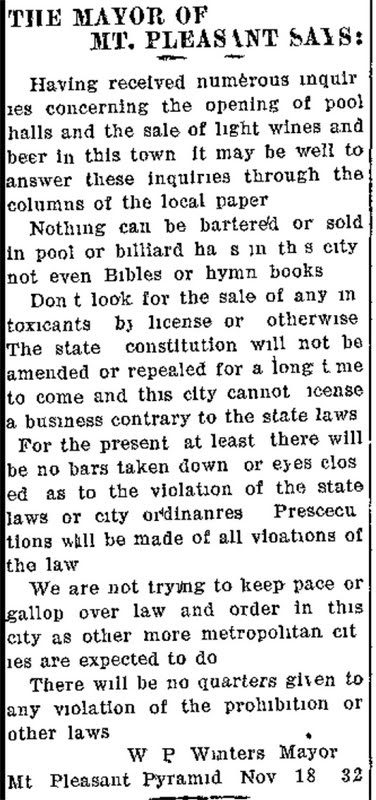
Mayor Winters and Prohibition 

~~~~~~~~~


Below is a notice of his second Marriage.


He married Mary M. Wilcox Patterson in 1947.
Doctor Winters and his second wife, Mae walking down the street. .
submitted by Marilain Black


Marilain Black, a granddaughter of Mary (May) Wilcox, second wife to doctor Winters shares with us a couple of interesting    stories: 

He (Doctor Winters) was her sweetheart before he became a Dr. I understand she married Joseph Sharp Patterson, Sr. on the rebound. 
My Great Grandmother, Candace Rowe Wilcox raised 8 children my grandmother
Mary M. Wilcox, was the eldest child and was 20 when her father died.  She (greatgrandmother)  became the local midwife and helped Dr. Wm. P. Winters (her oldest daughter's first sweetheart) when he was not available.  She was elected as City Treasurer on the Democratic ticket in Nov. 1987
Mary M. Wilcox Patterson  and Dr. Wm. P. Winters met again about 1947 and were married in Pocatello, Idaho by Bishop Henry B. West on 16 Jul 1947.  Dr. Winters and my grandmother
went on a honeymoon to California where his daughter, Louise, lived.  They were offered to be on a program for the oldest newlyweds but my grandmother refused.
He was 80 and she 79.  On their way back to Utah, they passed a terrible accident and stopped to administer first aid.  It was so bad, Dr. asked my grandmother to rip off her underclothes and used them to pack in the wounds.  Dr. Winters died after they had been married five years on 13 Jul 1952 in Price, Utah.  She died
8 Feb 1959 in Salt Lake City.
NOTE:  My grandmother was never called Mary.  We knew her by Dana and know she was called Mae by others.   


The following are items taken from the History of Mt. Pleasant by Hilda Madsen Longsdorf.


p. 195

In 1908, Dr. August Lundberg purchased the first two auto­mobiles brought to Mt. Pleasant. The first, a "Lokomobile" was, however, of short duration, for in the course of a month or so he purchased another, this was a large red touring car called the "Northerner."
In 1909, Dr. W. P. Winters purchased a Buick, and Frank Waldermar an E. M. F. About a year or so later, Christian Hansen purchased a ,Buick, Showman Longsdorf, a Case, and F. C. Jensen, a Cadillac. Among other early cars were those owned by Lyman Aldrich, Wallace Petty and Hyrum Merz. All these cars were very popular with the pleasure seekers and a great deal of time was spent on the road. 


p. 238  1932-33. Mayor, W. P. Winters; Recorder, Daniel Rasmussen; Treasurer, Pearl Larsen; Councilors, H. P. Olsen, four years;Ed. Johnston, John Fowles, Willis N. Madsen, E. W. Wall.


Friday, July 15, 2011

Bent Richard Hansen ~ Mayor of the Month July 2011


The following excerpts are taken from Hilda Madsen Longsdorf, History of Mt. Pleasant.  


The early entries may have been Bendt Hansen Sr., father to Bent Richard Hansen

p. 63


Fortunate were the pioneers in having among them so many fine musicians, who willingly contributed their talents toward the amusement of the colony.  John Waldermar played the violin, flute,


and cornet. James Hansen, who prior to his coming to Mount Pleasant, had belonged to the Brass Band in Salt Lake City, also played the violin, flute and cornet. Lars Nielsen, known as Lars Fiddler, played by ear, became very popular and had many 
invi­tations from other settlements to locate there. He, with John Waldermar and James Hansen, played for all the important gatherings held in Mount Pleasant during the first sixteen years.

Among other prominent pioneer musicians, who also contributed necessary pioneer music were Levi B. Reynolds, violinist; George Nielsen, tambourine; Orin Clark, the Jaw Bones of an Ox on a stick; Alma Staker, Bone Clapper; Rudolph Bennett, Triangle; Bent Hansen, Bass Fiddle; Soren Hansen, Clarinet; Andrew Bram­sted, Violin; and August Mynear, Violin.

pp. 91-92

The calling of people to bring the immigrants worked a hard­ship on the people as did the calling to go and assist in the settling of new settlements. All sacrificed much in selling their homes for a little or nothing, and realized scarcely enough to move their families and relocate at the places to which they had been called. Knowing that President Young fully realized the necessity of opening up the settlements in preparation for the many immi­grants from the United States and Europe, who were mostly poor people or had spent nearly all they had in coming to Utah; the Saints felt it their duty to respond, with a feeling of good will, when called. During the summer, considerable flour was hauled to Salt Lake City where it was marketed at $18.00 a hundred. The demand came side of Main Street between Second and Third West, on the lot later owned by Bent Hansen. Here the people were furnished a market for their grain in exchange for merchandise. The store was managed by Joseph Stanford, and for a time, Anthon H. Lund and Charlie Hampshire clerked there.


p. 105

On that day also, the following were called as missionaries to settle on the Muddy, at that time thought to be in Utah but later survey showed it in Nevada. John L. Ivie, Paul Stark, Peter Nielsen, C. P. Larsen, James Christensen (Harbro), George Meyrick, Bent Hansen, Mortin Rasmussen, Soren Jacob­sen and Hyrum Winters.


            p.126

President Brigham Young's Visit

September 12th, President Brigham Young and a number of the apostles and elders visited Mount Pleasant. A suitable wagon, drawn by four fine horses, was fitted up and driven by Rasmus Frandsen and Andrew Madsen, taking the Mount Pleasant Brass Band to Fountain Green, where they met the party. Coming back by way of Moroni, they led the procession and furnished the music. James Hansen leading the band, among others who were members were John Waldermar, Daniel Beckstrom, Andrew Beckstrom, Andrew Anderson, Bent Hansen and Mortin Rasmussen.

p. 132

John Hastler had arrived in Mt. Pleasant in October and brought with him a full set of musical instruments from Switzerland. Bishop Seeley and the leading brethren engaged him to organize a Brass Band at once. This was affected about the 15th of October, 1869, with John Hastler, James Hansen, Bent Hansen, John Waldermar, Andrew Beckstrom, Daniel Beckstrom. James C. Meiling, August Wall, Aaron Oman, Peter Syndergaard. Andrew Syndergaard, Soren Hansen, Lars Nielsen (Fiddler), Mortin Rasmussen, Jacob Hafen, Ulrich Winkler, Oscar Barton, Charlie Hampshire, and Paul Coates. John Hastler and Olaf Rosen­lof were chosen as their leaders.


p. 161


In 1883, Bent Hansen &  Sons opened a planing mill on the north side of Main Street between Second and Third West. At about the same time, J. B. Staker and Ephraim Hansen also operated a similar mill west on Second North between State and First West. George and Joseph Frandsen were later among the prominent lumber dealers.


p. 173

The scenery for the hall was painted by C. C. A. Christensen, a very popular artist. Music for the dances was mostly furnished by the Peter Almertz orchestra, consisting of John Waldermar, Rebecca Beckstrom, Bent Hansen, and others. Brigham Lee was floor manager and prompter. The east room of the building was used as the city council headquarters. On top of the building had been arranged seats, and at daybreak on holidays the Brass Band assembled; their music could be clearly heard in the distance, as the stars and stripes were unfurled. It had been common for the band, in their band wagon, to serenade the city, and they were usually treated with plenty of home-made beer and refreshments.


p. 174

April 14, 1894, the militia was organized in Mt. Pleasant. This company was known as Company C, First Infantry, and was mus­tered in by Colonel Tatlock, with Thomas Braby, Captain; Daniel C. Jensen, First Lieutenant; Magnus G. Rolph, Second Lieutenant, and was commissioned by Kaleb W. West, the last Territorial Governor. The company consisted of the following: Thomas Braby, Daniel C. Jensen, M. G. Rolph, J. M. Boyden, M. A. Boy­den, W. E. Watson, L. P. Nelson, J. W. Lowe, John Forsland. A. B. Williams, G. W. Thompson, B. C. Skillicorn, Willie Ander­son, Ferdinand Ericksen, Charles Hampshire, Axel Bjelke, E. W. Wall, Ole Olson, Clarence Winters, W. P. Winters, George W. Reynolds, John O. Lofgren, J. B. Porter, Andrew L. Porter, Byron G. Wheelock, George Christensen, Henry Ericksen, Erick H. Erick­sen, Olaf C. Andersen, John Knudsen, Amasa Aldrich, James Jor­gensen, James F. Jensen, Louis H. Brand, George Brand, George M. Miller, William B. Allen, Bent R. Hansen, L. 1. Harward, Olaf Rosenlof, John H. Hansen, Arthur McArthur.


p. 181

Bent Hansen and Company purchased in 1899 the first buggy hearse used in the city, and September 14, 1899, James Hansen, a brother of Bent Hansen Sr., was the first corpse to be taken in it to the cemetery. This hearse was always drawn by a pair of cream colored horses.

p. 196

High School District Organized

In 1911, Mt. Pleasant voted to build a high school building. (North Sanpete High School). At that time, the school trustees were C. N. Lund, J. M. Boyden and, Bent R. Hansen.


p. 202

In 1926, Mr. 'Bent R. Hansen, then a local undertaker, pur­chased the first automobile hearse used in Mt. Pleasant. After Mr. Hansen's death in 1933, the business was carried on by H. C. Jacobs, who purchased their building and established the Jacobs Mortuary.


p. 238

1928-29. Mayor, Bent R. Hansen; Recorder, James Jordan (re­signed, and Calvin Christensen appointed; Treasurer, Effie R. Larsen; Councilors, Paul Monsen, four years; M. C. Peterson, E. W. Wall, Wm. L. Madsen, J. D. Meyrick.


Wednesday, June 15, 2011

Joseph Seely, Mayor of the Month ~ June 2011 ~ He served during 1926 and 1927.

The following notes are taken from Hilda Madsen Longsdorf's "History of Mt. Pleasant".
 Pages 184-185:  A conference was held, after a few minutes discussion, they were united and agreed upon calling a mass meeting on the 17th day of February, 1909. At this meeting, Daniel Rasmussen was elected chairman and Joseph Seely secretary. The plan was pre­sented to erect in some suitable place, a large monument in honor of the Pioneers. After a few minutes discussion, this was unanimously agreed upon.
A conference was held, after a few minutes discussion, they were united and agreed upon calling a mass meeting on the 17th day of February, 1909. At this meeting, Daniel Rasmussen was elected chairman and Joseph Seely secretary. The plan was pre­sented to erect in some suitable place, a large monument in honor of the Pioneers. After a few minutes discussion, this was unanimously agreed upon.
Two committees were appointed. One, Ferdinand Ericksen. E. C. Johnson, James Larsen, James Monsen, and Andrew Madsen, to select the character of monument to be erected, and a like com­mittee, consisting of five members, Daniel Rasmussen, Joseph Seely, James Borg, C. W. Anderson and Joseph Monsen, were to devise ways and means by which to raise the necessary funds for the erection of a suitable memorial.
February 27th, another meeting was called and the two com­mittees were consolidated. The committees worked earnestly and it was only by stick-to-it-tive-ness and constant efforts with renew­ed vigor that they were able to make such rapid advancement.
The census of the descendants were taken and an assessment of $35.00 to the family was made. Any male in Mt. Pleasant over ten years of age in 1859, was eligible to have his name on the monument. Some responded promptly, while some were lax. Madsen made a trip to Carbon County, meeting with a number of the descendents at Price and Wellington, who, after receiving full explanation of the progress and intentions of the committee, did not hesitate and at once contributed their portion. In March, a mass meeting was held to prepare for the celebration. The city
appointed the following committee chairmen: 
James Monsen  general chairman; C. N. Lund, program; Daniel Rasmussen,  

decoration; W. D. Candland, finance; Ferdinand Ericksen, amusement; Joseph Seely, entertainment; and also made an appropria­tion of $200.00.
The work was completed in due time and a beautiful monu­ment, which is composed of white bronze metal was erected on the northwest corner of the Church Block, intersecting Main and State Streets. It stands upon a cement foundation, ten feet square, and is surmounted by six foot figure representing "Faith" typi­fying the devotion and confidence of the Pioneers. The total height of the monument is twenty-seven feet, six inches. The estimated cost about $2,500.00 p. 194: After the Pioneer Monument was erected and the committee who had charge of it considered their work practically finished. Andrew Madsen proposed that the present committee be dissolved and that a permanent organization be formed, consisting of pio­neers and descendants of pioneers from 1859 to 1869. He further suggested that the present committee, naturally very much inter­ested, be retained and that four women be added to the committee. Later a meeting was held at the North Ward Chapel and an or­ganization formed, the name Mt. Pleasant Pioneer Historical Asso­ciation was adopted. It was decided to meet annually in March. The following officers were elected: President, Andrew Madsen; Vice President, James Larsen; Secretary, Daniel Rasmussen. Treasurer, James Monsen; Directors, Ferdinand Ericksen, Joseph Monsen, Edmund C. Johnson, James Borg, Joseph Seely, Chris­tian W. Anderson, Mr. John H. Seely, Mrs. Henry Ericksen, Mrs. Miranda Omenn, and Mrs. Thomas West. p 203: September 3, 1927, Colonel Charles A. Lindberg, aboard his famous Spirit of St. Louis, flying from Cheyenne, Wyoming, en­
route to Salt Lake City, paused to greet the citizens of Mt. Pleasant. He arrived over the mountains east of the city.
Mayor Joseph Seely having received a telegram announcing his intentions, Mt. Pleasant had been gaily decorated for the oc­casion and all was in readiness to receive him. The massive plane from which a message of greeting was dropped, circled low sev­eral times over the city. After a stay of about fifteen minutes, he left by way of Fairview for Salt Lake City.
       During 1928, the Mt. Pleasant Press, a weekly newspaper, was
published by Margaret DeLay and R. V. Tuve.
In 1929, O. M. Aldrich and Sons, Ray and Clair, purchased the building erected and formerly occupied by the Sanpete County Co-op, and there established a general merchandise business.
p 238: 1926-27. Mayor, Joseph Seely; Recorder, Calvin Christensen; Treasurer, Effie R. Larsen; Councilors, M. C. Peterson, four years; C. L. Stewart, Paul Monsen, Joseph Monsen, O. F. Wall.
p 257:  Alif Ericksen was chosen as president of the North Ward, with Hans Madsen and Joseph Seely as counselors; Lars Christian 
Ras­mussen, Secretary.
The North Ward Association was re-organized November 2, 1886, as follows: Joseph Madsen, president; Mangus G. Rolph and William Sorensen, counselors. The South Ward Association was re-organized with George Christensen as president; Ferdinand Clark and Lauritz Clark, counselors; Ferdinand Ericksen, Secre­tary. Mangus G. Rolph became president of the Ward February 29, 1888. 
p 328:  Other meat dealers were DeLong, Niels Rasmussen, Evan Ivie, and Keen Tidwell. In 1889 the Ericksen Meat & Grocery Company was established by Henry Ericksen and Alif Ericksen. Later Joseph Seely, Al Peterson, John Ericksen, Andrew O. Mad­sen, and Stewart Seely were located on the north side of Main Street, between State and First West. 

Thursday, June 9, 2011

Robert H. Hinckley ~ Mayor of the Month ~ May 2011 ~ He Served As Mayor 1924-1925


The following are are references and page numbers to Robert H. Hinckley from Hilda Madsen Longdorf's "History of Mt. Pleasant".


June 24, 1917, Mary Elizabeth, thirteen months old child of Charles M. and Josephine Peterson, was drowned in Twin Creek channel east of the city.


For a number of years, a Traveling Library, free to the public, was sponsored by members of the Twentieth Century Literary Club and the Home Culture Club of Mt. Pleasant.


During Daniel Rasmussen's term as mayor, the Carnegie Li­brary was built, being formally opened to the public, February 15, 1917. This year the Seely-Hinckley building, corner First West and Main, was built by John H. Seely and Robert H. Hinckley.  P 199


In December 1925, during Robert H. Hinckley's term as mayor, the White Way was completed by the paving of Main Street. This was celebrated by an appropriate program and danc­ing on the pavement. This year the Lion's Club was organized in Mt. Pleasant, with Charles Eatinger as president, and Earl F. Gardemann, as secretary. P 202


The new city hall was dedicated August 23rd. Following  aparade, a program was held on the steps of the building. Senator Ed Johnston presided. Invocation was offered by Daniel  Rasmussen and the dedicatory prayer by C. W. Sorensen, and an historical sketch was given by Mrs. S. D. Longsdorf. Talks by Judge.  George Christensen, of Price; Robert H. Hinckley, of Ogden, Chairman Civil Aeronautics Commission; and Darrell Greenwell, of Salt Lake City, State WP A Director, who also, in behalf of the WP A, presented the building to Mt. Pleasant. The response and acceptance speech was given by Councilman A. L. Peterson. Mus­ical numbers were rendered by Mr. and Mrs. Roger Hansen, Dean and Wayne Peterson, Grant, Vernon, and Don Johansen, Mrs. G. B. Madsen, Mrs. S. H. Gill, and Mrs. H. G. Ericksen. P 207-208


1924-25. Mayor, Robert H. Hinckley; Recorder, Calvin Christen­sen; Teasurer, Effie R. Larsen; Councilors, O. F. Wall, four years; P. A. Poulsen, Joseph Matson, M. C. Petersen, Joseph Johansen Jr.


P 238