Saturday, October 15, 2011

Justus Olson Seely ~ Mayor of the Month ~ October 2011 ~ Elected 1936


The following items come from Hilda Madsen Longsdorf "History of Mt. Pleasant".


 P.  194:  The  (Pioneer) committee at the present time, 1939, is as follows: President- James Larsen; Vice President-James Monsen; Secretary & Treasurer-Mrs. Hilda Madsen Longsdorf; Assistant-O. M. Aldrich; Directors-E. C. Johnson, Mrs. Miranda Omenn, L. C. Ramussen, Mrs. Botilda Frandsen, Fred Staker, Royal Candland. Daniel Rasmussen, Mrs. Ella Tuft Candland, Justus O. Seely, C. T. Madsen, F. J. Nielsen, Vern H. Gunderson, and
Elmer Jensen.


      P. 239:   1936-37. Mayor, Justus O. Seely; Recorder, E. W. Wall; Treas­urer, Mata Hutchison; Councilors, J. H. Stansfield, four years; P. A. Poulson, (Dr.) A. L. Peterson, Lawrence Winters, Bert Wright; W. K. Peterson and Sheldon Monsen appointed city Marshals.
1938-39. Mayor, Justus O. Seely; Recorder, E. W. Wall; Treas­urer, Mata Hutchison; Councilors, P. A. Poulson, four years; J. H. Stansfield, (Dr.) A. L. Peterson, (Dr.) L. A. Phillips, W. C. Olsen.

     P. 247:  Listed with names of Veterans on Doughboy Monument:

Shelley, David A. Shelley, Jesse
Scow, Andrew Lavor Selby, John Jr.
Seely, Chesley P. Seely, Leonard J
Seely, Justus O.


Sunday, September 25, 2011

Ed Johnston ~ Mayor of the Month ~ September 2011 ~ 1834-35


Once again we have a former mayor  with no formal biography readily available.  No descendants locally available to glean information from.  It anyone out there can fill in the blanks, a very large one ________,please do.  So we have collected tidbits of information from Hilda's History of Mt. Pleasant and also from Utah Digital Newspapers, which is a wonderful resource.Family Search has a number of Ed Johnstons so we cannot be sure whose his parents were and where he came from.  We do know he was the Mayor of Mt. Pleasant.  We know that he went on to be a Utah State Senator.  We know that he owned and operated Johnston's Drug Store. And we know that he was once President of the Utah Pharmaceutical Association.  He joined the Royal Arch Masons of Mt. Pleasant, and was scribe, as well as Worshipful Master. He was also a veteran of the Spanish American War. He must have been a very influential and well liked gentleman. 

The following are the news clippings we have found on Ed Johnston:


The above article appeared in the Manti Messenger on 
September 9, 1938.


The above was found in the Manti Messanger February 14, 1941


Items about Ed Johnston in History of Mt. Pleasant by Hilda Madsen Longsdorf
P. 13:
Mount Pleasant is pleasantly located in the northern part of Sanpete County, Utah, about one hundred miles southeast of Salt Lake City. It is situated on Pleasant Creek, one of the tributaries to the Sevier River, and about midway between the Wasatch plateau on the east and the Sanpitch River on the west. Its ele­vation, as registered on a standard disk, set in the northwest corner of the west wall of Johnston's drug store, S. W. corner of the intersection of State and Main, is 5,923.97 feet, and as registered in standard disk, set in stone head wall of irrigation ditch, ninety feet southwest of D. & R. G. Depot and thirty feet west of center of railroad track is 5,843.67, showing a gentle slope which gives excellent drainage. The United States census of 1930 shows its population as being at that time 2628, with Manti 2240 and Ephraim 2076.

 P. 199:
The Sanpete County Council of Defense was organized as follows: J. W. Cherry, chairman; Burke McArthur, secretary; Ed. Johnston, treasurer; Committee chairmen, Finance, N. S. Niel­sen; Publicity, ,Burke McArthur; Legal, J. W. Cherry; Sanitation and Medicine, Ed. Johnston; Food supply and conservation, L. R. Anderson; Industrial survey, Orlando Bradley; Labor, Christian Willardsen; Military affairs, J. Morgan Johnson; State protection, H. R. Thomas; Survey of man power, L. P. Brady; Woman's work, Mrs. G. W. Martin.

P. 201:
In January of 1922, Ed. Johnston moved his drug stock into his new building, corner of State and Main, and during the year, the Wasatch Academy completed their two buildings, the gymnasi­um and the Infirmary.

P. 204:
February 12, 1936, Ray K. Bohne was appointed postmaster. and after a short time, the office was moved to the Ed. Johnston building.

P. 206:
The new city hall was dedicated August 23rd. Following  parade, a program was held on the steps of the building. Senator Ed Johnston presided. Invocation was offered by Daniel  Rasmussen and the dedicatory prayer by C. W. Sorensen, and an historical sketch was given by Mrs. S. D. Longsdorf.

P. 238:
1932-33. Mayor, W. P. Winters; Recorder, Daniel Rasmussen;
      Treasurer, Pearl Larsen; Councilors, H. P. Olsen, four years;
      Ed. Johnston, John Fowles, Willis N. Madsen, E. W. Wall.
1934-35. Mayor, Ed. Johnston; Recorder, E. W. Wall; Treasurer,
      Pearl Larsen; Councilors, Willis N. Madsen, four years; Henry
      P. Olsen, John Fowles, Parley Hansen, Daniel Rasmussen,
      (21) Lawrence Winters.

P. 324:
(1935) A portion of the old fort wall was still standing. James Wilson had a blacksmith shop on the corner where Mayor Ed Johnston now has a drug store. Peter Matson had a shoe store and Lydia T. Winters ran a millinery store. The Presbyterian Church was where the Mason Lodge Hall is now. James Borg and Ole Clemen­sen had a harness shop near the Beaumann home, and Abner Crane had a blacksmith shop near where the Crane home is now.


Tuesday, September 6, 2011

Doctor W. P. Winters ~ Mayor of the Month ~ August 2011

http://mtpleasantpioneer.blogspot.com/2011/08/doctor-w-p-winters-mayor-of-month.html


We were not able to find a regular biography of Dr. W. P. Winters.  We searched the internet and talked with people who knew him.  The following is a mixture of items we were able to find.  Peter Hafen remembers him to be a very jovial fellow.  He and his second wife, Mae were frequent visitors at the home of  Peter's "Uncle Dutch" and Aunt Johanna Hafen.


William Philitis Winters was born 24 April 1868. 
Father Henry Adelbert Winters,
Mother: Elizabeth Williams.
He married Nancy Jane Cummings in 1895. She Passed away in 1946.
He married Mary M. Wilcox Patterson in 1947.  Mary (Mae) was also from Mt. Pleasant.
Mae was the daughter of Joseph and Candace Rowe Wilcox.
Candace Rowe Wilcox was a local midwife and assisted Dr. Winters.


He died 10 July 1952 in Price, Utah.  He is buried in Mt. Pleasant.

He started his medical career in Castle Dale, but later moved his practice to Mt. Pleasant


Dr. Winters Hospital as it looks today.  Location:  149 South 100 West, Mt. Pleasant, Utah
News of his aged  father's dying.

1923 He was proprietor of Carbon Hospital in
Price, Utah
~~~~~~~~~


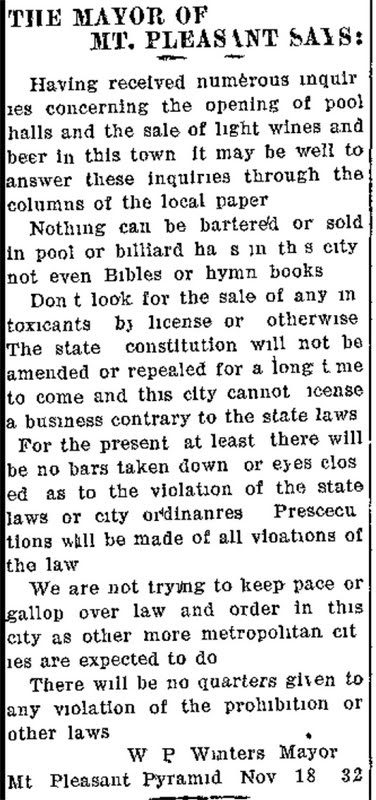
Mayor Winters and Prohibition 

~~~~~~~~~


Below is a notice of his second Marriage.


He married Mary M. Wilcox Patterson in 1947.
Doctor Winters and his second wife, Mae walking down the street. .
submitted by Marilain Black


Marilain Black, a granddaughter of Mary (May) Wilcox, second wife to doctor Winters shares with us a couple of interesting    stories: 

He (Doctor Winters) was her sweetheart before he became a Dr. I understand she married Joseph Sharp Patterson, Sr. on the rebound. 
My Great Grandmother, Candace Rowe Wilcox raised 8 children my grandmother
Mary M. Wilcox, was the eldest child and was 20 when her father died.  She (greatgrandmother)  became the local midwife and helped Dr. Wm. P. Winters (her oldest daughter's first sweetheart) when he was not available.  She was elected as City Treasurer on the Democratic ticket in Nov. 1987
Mary M. Wilcox Patterson  and Dr. Wm. P. Winters met again about 1947 and were married in Pocatello, Idaho by Bishop Henry B. West on 16 Jul 1947.  Dr. Winters and my grandmother
went on a honeymoon to California where his daughter, Louise, lived.  They were offered to be on a program for the oldest newlyweds but my grandmother refused.
He was 80 and she 79.  On their way back to Utah, they passed a terrible accident and stopped to administer first aid.  It was so bad, Dr. asked my grandmother to rip off her underclothes and used them to pack in the wounds.  Dr. Winters died after they had been married five years on 13 Jul 1952 in Price, Utah.  She died
8 Feb 1959 in Salt Lake City.
NOTE:  My grandmother was never called Mary.  We knew her by Dana and know she was called Mae by others.   


The following are items taken from the History of Mt. Pleasant by Hilda Madsen Longsdorf.


p. 195

In 1908, Dr. August Lundberg purchased the first two auto­mobiles brought to Mt. Pleasant. The first, a "Lokomobile" was, however, of short duration, for in the course of a month or so he purchased another, this was a large red touring car called the "Northerner."
In 1909, Dr. W. P. Winters purchased a Buick, and Frank Waldermar an E. M. F. About a year or so later, Christian Hansen purchased a ,Buick, Showman Longsdorf, a Case, and F. C. Jensen, a Cadillac. Among other early cars were those owned by Lyman Aldrich, Wallace Petty and Hyrum Merz. All these cars were very popular with the pleasure seekers and a great deal of time was spent on the road. 


p. 238  1932-33. Mayor, W. P. Winters; Recorder, Daniel Rasmussen; Treasurer, Pearl Larsen; Councilors, H. P. Olsen, four years;Ed. Johnston, John Fowles, Willis N. Madsen, E. W. Wall.


Friday, July 15, 2011

Bent Richard Hansen ~ Mayor of the Month July 2011


The following excerpts are taken from Hilda Madsen Longsdorf, History of Mt. Pleasant.  


The early entries may have been Bendt Hansen Sr., father to Bent Richard Hansen

p. 63


Fortunate were the pioneers in having among them so many fine musicians, who willingly contributed their talents toward the amusement of the colony.  John Waldermar played the violin, flute,


and cornet. James Hansen, who prior to his coming to Mount Pleasant, had belonged to the Brass Band in Salt Lake City, also played the violin, flute and cornet. Lars Nielsen, known as Lars Fiddler, played by ear, became very popular and had many 
invi­tations from other settlements to locate there. He, with John Waldermar and James Hansen, played for all the important gatherings held in Mount Pleasant during the first sixteen years.

Among other prominent pioneer musicians, who also contributed necessary pioneer music were Levi B. Reynolds, violinist; George Nielsen, tambourine; Orin Clark, the Jaw Bones of an Ox on a stick; Alma Staker, Bone Clapper; Rudolph Bennett, Triangle; Bent Hansen, Bass Fiddle; Soren Hansen, Clarinet; Andrew Bram­sted, Violin; and August Mynear, Violin.

pp. 91-92

The calling of people to bring the immigrants worked a hard­ship on the people as did the calling to go and assist in the settling of new settlements. All sacrificed much in selling their homes for a little or nothing, and realized scarcely enough to move their families and relocate at the places to which they had been called. Knowing that President Young fully realized the necessity of opening up the settlements in preparation for the many immi­grants from the United States and Europe, who were mostly poor people or had spent nearly all they had in coming to Utah; the Saints felt it their duty to respond, with a feeling of good will, when called. During the summer, considerable flour was hauled to Salt Lake City where it was marketed at $18.00 a hundred. The demand came side of Main Street between Second and Third West, on the lot later owned by Bent Hansen. Here the people were furnished a market for their grain in exchange for merchandise. The store was managed by Joseph Stanford, and for a time, Anthon H. Lund and Charlie Hampshire clerked there.


p. 105

On that day also, the following were called as missionaries to settle on the Muddy, at that time thought to be in Utah but later survey showed it in Nevada. John L. Ivie, Paul Stark, Peter Nielsen, C. P. Larsen, James Christensen (Harbro), George Meyrick, Bent Hansen, Mortin Rasmussen, Soren Jacob­sen and Hyrum Winters.


            p.126

President Brigham Young's Visit

September 12th, President Brigham Young and a number of the apostles and elders visited Mount Pleasant. A suitable wagon, drawn by four fine horses, was fitted up and driven by Rasmus Frandsen and Andrew Madsen, taking the Mount Pleasant Brass Band to Fountain Green, where they met the party. Coming back by way of Moroni, they led the procession and furnished the music. James Hansen leading the band, among others who were members were John Waldermar, Daniel Beckstrom, Andrew Beckstrom, Andrew Anderson, Bent Hansen and Mortin Rasmussen.

p. 132

John Hastler had arrived in Mt. Pleasant in October and brought with him a full set of musical instruments from Switzerland. Bishop Seeley and the leading brethren engaged him to organize a Brass Band at once. This was affected about the 15th of October, 1869, with John Hastler, James Hansen, Bent Hansen, John Waldermar, Andrew Beckstrom, Daniel Beckstrom. James C. Meiling, August Wall, Aaron Oman, Peter Syndergaard. Andrew Syndergaard, Soren Hansen, Lars Nielsen (Fiddler), Mortin Rasmussen, Jacob Hafen, Ulrich Winkler, Oscar Barton, Charlie Hampshire, and Paul Coates. John Hastler and Olaf Rosen­lof were chosen as their leaders.


p. 161


In 1883, Bent Hansen &  Sons opened a planing mill on the north side of Main Street between Second and Third West. At about the same time, J. B. Staker and Ephraim Hansen also operated a similar mill west on Second North between State and First West. George and Joseph Frandsen were later among the prominent lumber dealers.


p. 173

The scenery for the hall was painted by C. C. A. Christensen, a very popular artist. Music for the dances was mostly furnished by the Peter Almertz orchestra, consisting of John Waldermar, Rebecca Beckstrom, Bent Hansen, and others. Brigham Lee was floor manager and prompter. The east room of the building was used as the city council headquarters. On top of the building had been arranged seats, and at daybreak on holidays the Brass Band assembled; their music could be clearly heard in the distance, as the stars and stripes were unfurled. It had been common for the band, in their band wagon, to serenade the city, and they were usually treated with plenty of home-made beer and refreshments.


p. 174

April 14, 1894, the militia was organized in Mt. Pleasant. This company was known as Company C, First Infantry, and was mus­tered in by Colonel Tatlock, with Thomas Braby, Captain; Daniel C. Jensen, First Lieutenant; Magnus G. Rolph, Second Lieutenant, and was commissioned by Kaleb W. West, the last Territorial Governor. The company consisted of the following: Thomas Braby, Daniel C. Jensen, M. G. Rolph, J. M. Boyden, M. A. Boy­den, W. E. Watson, L. P. Nelson, J. W. Lowe, John Forsland. A. B. Williams, G. W. Thompson, B. C. Skillicorn, Willie Ander­son, Ferdinand Ericksen, Charles Hampshire, Axel Bjelke, E. W. Wall, Ole Olson, Clarence Winters, W. P. Winters, George W. Reynolds, John O. Lofgren, J. B. Porter, Andrew L. Porter, Byron G. Wheelock, George Christensen, Henry Ericksen, Erick H. Erick­sen, Olaf C. Andersen, John Knudsen, Amasa Aldrich, James Jor­gensen, James F. Jensen, Louis H. Brand, George Brand, George M. Miller, William B. Allen, Bent R. Hansen, L. 1. Harward, Olaf Rosenlof, John H. Hansen, Arthur McArthur.


p. 181

Bent Hansen and Company purchased in 1899 the first buggy hearse used in the city, and September 14, 1899, James Hansen, a brother of Bent Hansen Sr., was the first corpse to be taken in it to the cemetery. This hearse was always drawn by a pair of cream colored horses.

p. 196

High School District Organized

In 1911, Mt. Pleasant voted to build a high school building. (North Sanpete High School). At that time, the school trustees were C. N. Lund, J. M. Boyden and, Bent R. Hansen.


p. 202

In 1926, Mr. 'Bent R. Hansen, then a local undertaker, pur­chased the first automobile hearse used in Mt. Pleasant. After Mr. Hansen's death in 1933, the business was carried on by H. C. Jacobs, who purchased their building and established the Jacobs Mortuary.


p. 238

1928-29. Mayor, Bent R. Hansen; Recorder, James Jordan (re­signed, and Calvin Christensen appointed; Treasurer, Effie R. Larsen; Councilors, Paul Monsen, four years; M. C. Peterson, E. W. Wall, Wm. L. Madsen, J. D. Meyrick.


Wednesday, June 15, 2011

Joseph Seely, Mayor of the Month ~ June 2011 ~ He served during 1926 and 1927.

The following notes are taken from Hilda Madsen Longsdorf's "History of Mt. Pleasant".
 Pages 184-185:  A conference was held, after a few minutes discussion, they were united and agreed upon calling a mass meeting on the 17th day of February, 1909. At this meeting, Daniel Rasmussen was elected chairman and Joseph Seely secretary. The plan was pre­sented to erect in some suitable place, a large monument in honor of the Pioneers. After a few minutes discussion, this was unanimously agreed upon.
A conference was held, after a few minutes discussion, they were united and agreed upon calling a mass meeting on the 17th day of February, 1909. At this meeting, Daniel Rasmussen was elected chairman and Joseph Seely secretary. The plan was pre­sented to erect in some suitable place, a large monument in honor of the Pioneers. After a few minutes discussion, this was unanimously agreed upon.
Two committees were appointed. One, Ferdinand Ericksen. E. C. Johnson, James Larsen, James Monsen, and Andrew Madsen, to select the character of monument to be erected, and a like com­mittee, consisting of five members, Daniel Rasmussen, Joseph Seely, James Borg, C. W. Anderson and Joseph Monsen, were to devise ways and means by which to raise the necessary funds for the erection of a suitable memorial.
February 27th, another meeting was called and the two com­mittees were consolidated. The committees worked earnestly and it was only by stick-to-it-tive-ness and constant efforts with renew­ed vigor that they were able to make such rapid advancement.
The census of the descendants were taken and an assessment of $35.00 to the family was made. Any male in Mt. Pleasant over ten years of age in 1859, was eligible to have his name on the monument. Some responded promptly, while some were lax. Madsen made a trip to Carbon County, meeting with a number of the descendents at Price and Wellington, who, after receiving full explanation of the progress and intentions of the committee, did not hesitate and at once contributed their portion. In March, a mass meeting was held to prepare for the celebration. The city
appointed the following committee chairmen: 
James Monsen  general chairman; C. N. Lund, program; Daniel Rasmussen,  

decoration; W. D. Candland, finance; Ferdinand Ericksen, amusement; Joseph Seely, entertainment; and also made an appropria­tion of $200.00.
The work was completed in due time and a beautiful monu­ment, which is composed of white bronze metal was erected on the northwest corner of the Church Block, intersecting Main and State Streets. It stands upon a cement foundation, ten feet square, and is surmounted by six foot figure representing "Faith" typi­fying the devotion and confidence of the Pioneers. The total height of the monument is twenty-seven feet, six inches. The estimated cost about $2,500.00 p. 194: After the Pioneer Monument was erected and the committee who had charge of it considered their work practically finished. Andrew Madsen proposed that the present committee be dissolved and that a permanent organization be formed, consisting of pio­neers and descendants of pioneers from 1859 to 1869. He further suggested that the present committee, naturally very much inter­ested, be retained and that four women be added to the committee. Later a meeting was held at the North Ward Chapel and an or­ganization formed, the name Mt. Pleasant Pioneer Historical Asso­ciation was adopted. It was decided to meet annually in March. The following officers were elected: President, Andrew Madsen; Vice President, James Larsen; Secretary, Daniel Rasmussen. Treasurer, James Monsen; Directors, Ferdinand Ericksen, Joseph Monsen, Edmund C. Johnson, James Borg, Joseph Seely, Chris­tian W. Anderson, Mr. John H. Seely, Mrs. Henry Ericksen, Mrs. Miranda Omenn, and Mrs. Thomas West. p 203: September 3, 1927, Colonel Charles A. Lindberg, aboard his famous Spirit of St. Louis, flying from Cheyenne, Wyoming, en­
route to Salt Lake City, paused to greet the citizens of Mt. Pleasant. He arrived over the mountains east of the city.
Mayor Joseph Seely having received a telegram announcing his intentions, Mt. Pleasant had been gaily decorated for the oc­casion and all was in readiness to receive him. The massive plane from which a message of greeting was dropped, circled low sev­eral times over the city. After a stay of about fifteen minutes, he left by way of Fairview for Salt Lake City.
       During 1928, the Mt. Pleasant Press, a weekly newspaper, was
published by Margaret DeLay and R. V. Tuve.
In 1929, O. M. Aldrich and Sons, Ray and Clair, purchased the building erected and formerly occupied by the Sanpete County Co-op, and there established a general merchandise business.
p 238: 1926-27. Mayor, Joseph Seely; Recorder, Calvin Christensen; Treasurer, Effie R. Larsen; Councilors, M. C. Peterson, four years; C. L. Stewart, Paul Monsen, Joseph Monsen, O. F. Wall.
p 257:  Alif Ericksen was chosen as president of the North Ward, with Hans Madsen and Joseph Seely as counselors; Lars Christian 
Ras­mussen, Secretary.
The North Ward Association was re-organized November 2, 1886, as follows: Joseph Madsen, president; Mangus G. Rolph and William Sorensen, counselors. The South Ward Association was re-organized with George Christensen as president; Ferdinand Clark and Lauritz Clark, counselors; Ferdinand Ericksen, Secre­tary. Mangus G. Rolph became president of the Ward February 29, 1888. 
p 328:  Other meat dealers were DeLong, Niels Rasmussen, Evan Ivie, and Keen Tidwell. In 1889 the Ericksen Meat & Grocery Company was established by Henry Ericksen and Alif Ericksen. Later Joseph Seely, Al Peterson, John Ericksen, Andrew O. Mad­sen, and Stewart Seely were located on the north side of Main Street, between State and First West. 

Thursday, June 9, 2011

Robert H. Hinckley ~ Mayor of the Month ~ May 2011 ~ He Served As Mayor 1924-1925


The following are are references and page numbers to Robert H. Hinckley from Hilda Madsen Longdorf's "History of Mt. Pleasant".


June 24, 1917, Mary Elizabeth, thirteen months old child of Charles M. and Josephine Peterson, was drowned in Twin Creek channel east of the city.


For a number of years, a Traveling Library, free to the public, was sponsored by members of the Twentieth Century Literary Club and the Home Culture Club of Mt. Pleasant.


During Daniel Rasmussen's term as mayor, the Carnegie Li­brary was built, being formally opened to the public, February 15, 1917. This year the Seely-Hinckley building, corner First West and Main, was built by John H. Seely and Robert H. Hinckley.  P 199


In December 1925, during Robert H. Hinckley's term as mayor, the White Way was completed by the paving of Main Street. This was celebrated by an appropriate program and danc­ing on the pavement. This year the Lion's Club was organized in Mt. Pleasant, with Charles Eatinger as president, and Earl F. Gardemann, as secretary. P 202


The new city hall was dedicated August 23rd. Following  aparade, a program was held on the steps of the building. Senator Ed Johnston presided. Invocation was offered by Daniel  Rasmussen and the dedicatory prayer by C. W. Sorensen, and an historical sketch was given by Mrs. S. D. Longsdorf. Talks by Judge.  George Christensen, of Price; Robert H. Hinckley, of Ogden, Chairman Civil Aeronautics Commission; and Darrell Greenwell, of Salt Lake City, State WP A Director, who also, in behalf of the WP A, presented the building to Mt. Pleasant. The response and acceptance speech was given by Councilman A. L. Peterson. Mus­ical numbers were rendered by Mr. and Mrs. Roger Hansen, Dean and Wayne Peterson, Grant, Vernon, and Don Johansen, Mrs. G. B. Madsen, Mrs. S. H. Gill, and Mrs. H. G. Ericksen. P 207-208


1924-25. Mayor, Robert H. Hinckley; Recorder, Calvin Christen­sen; Teasurer, Effie R. Larsen; Councilors, O. F. Wall, four years; P. A. Poulsen, Joseph Matson, M. C. Petersen, Joseph Johansen Jr.


P 238


Friday, April 15, 2011

W. D. Candland ~ Mayor of the Month ~ April 2011


The following are references to W.D. Candland in the " History of Mt. Pleasant" by Hilda Madsen Longsdorf: 


    May 1893, the Mt. Pleasant Electric Light
Company filed articles of incorporation, with William Zabriskie, President, and     W. D. Candland as Secretary  p 172


There
were fully 500,000 head of sheep owned in the county, and with Mt. Pleasant,
the Queen City of Sanpete, fast becoming the commercial center, two prominent
wool companies were formed. In 1893 the Mt. Pleasant Wool & Live Stock
Company was organized by N. S. Nielsen, J. H. Seely, F. C. Jensen, James

In
1895 :

W.D. Candland was elected on the Republican ticket as the .first Senator from
Sanpete County.


February 1906, the North Sanpete Bank was
incorporated with a capital stock of $50,000.00. W. D. Candland,      president; A.
J. Aagard, vice president; and H. C. Beaumann, cashier. They were installed in
their new building on the 
north side of Main Street, midway between State and
First West. p 183

June
18, 1918, during W. D. Candland's term as mayor, Mt. Pleasant was visited by a
number of floods, one being the biggest in the history of the city. Great
boulders and rocks were carried with the stream of mud, damaging bridges and
fences, sweeping down the streets and through city lots, covering gardens and
filling basements, and completely filling the channels with debris, rocks, etc.


One life was lost, that of Louis Oldham, who, near his home east of the city,
slipped and fell into the stream. Some days later, his body was found in the
debris west of the city.

A few days after the flood, a group of convicts were
sent from the state penitentiary to assist in clearing out Pleasant Creek
channel. Many local men volunteered their assistance. p 200  


1918-19. Mayor, W. D.
Candland; Recorder, A. O. Neilson;    


     Treasurer, Hannah Barnette;
Councilors, John Gunderson, four

years; A. E. Mcintosh,
James Monsen, O. M. Aldrich, Bent R. Hansen. p 238


The flood gave W. D.
Candland and his associates financial and other troubles. A $25,000.00 bond
issue was voted for the purpose of piping pure spring water into the waterworks
system.


And now my friends, we
are in the hands of the undertaker. (Note: The mayor at that time, Bent R.
Hansen, was also an undertaker. ) p 242


It will perhaps be proper to
here give the names of those, who,


in addition to those
heretofore mentioned, assisted in instructing the youth up to about the year
1880.  Joseph S. Day, Joseph Page, John
Carter, Jeramiah D. Page,  Christina
Bertelsen,  Lucy Wheelock, Hans Jorgen
Shultz, Mrs. H. J. Hutchinson, John T. Henniger,  ­Eli A. Day, and Hilda Dehlin were those who
now come to the  memory of the writer.


A little later and in the
order given, the following teachers came upon the scene: Samuel H. Allen, Amasa
Aldrich, Abram Johnson, H. P. Jensen, Tina M. Morrison, Au­gusta Dehlin, Hans
Madsen, Joseph Madsen, George Christensen, C. W. Sorensen, William 1. Tidwell,
Ferdinand Ericksen, Ida Dehlin, Cecelia Winters, Olof C. Anderson, W. D.
Candland, and Som X. Christensen.  

pp 268,269

318


                        EXCERPTS FROM ADDRESS
             By W. D. Candland,
1922


I remember the days when the big drum was heard, and
the women, with blanched faces and trembling limbs, gathered their children
around them and fled to the fort; how men, with grim set faces, took their
ever-ready rifles from the wall and hastened to the square, ready to meet the
merciless, treacherous foe, know­ing how he lurked in the shadows, or stealthily
crawled on his belly to get near enough to fire a deadly shot. How the stoutest
hearts quailed when that blood-curdling yell broke on the still night air,
knowing it meant death in the most horrible form that the fiends could devise,
unless they could for the time beat them back.


I have watched the small hamlet founded by that brave and hardy band,
through all the vicissitudes of frontier perils, grow into a beautiful,
prosperous city. I have known their lives and aspirations, their hopes and fears,
and as they have been gathered one by one into the fold of the great beyond.


I desire to follow, for a few moments, another line of thought, and ask
you this question:


Did these things just happen in a haphazard way, or was there an
impelling, guiding force that actuated and directed events and caused men to
come here who were needed, whose training in various avocations, made them
exceedingly valuable in the new order of things?


If you say it was just an accident, you will admit at least it was
fortunate that William S. Seely, who had such a happy faculty of making friends
with the Indians, settled here.


Wasn't it fortunate that men and women settled here who could make the
things that were so sadly needed? That John Tidwell could make tubs and churns
and pails out of wood, bound


with
wooden hoops? That James Porter could take the hide from the ox and make it
into leather and then into shoes? That Abram Day knew how to survey and build
roads and sawmills? That Fechser and others knew how to build a flour mill?
That P. M. Peel could fashion things from iron and make a threshing ma­chine?
That Erick Gunderson was a carpenter? That Alma Staker

319

and Paul Dehlin could
make furniture? That Wellington Seely could set broken bones and pull teeth?
But most fortunate and most wonderful of all were the women, brave as their
husbands, and even more industrious, who could shear the sheep, wash, card, and
spin the wool, weave it into cloth, then make from the cloth raiment for the
whole family and the blankets and sheets they slept in. The men did nobly, but
my admiration and- respect, my profound reverence, is for the women who not
only performed their full measure of the work, but went many times into the
shadows of the valley of death in the throes of motherhood; their names are not
engraved on the monument, but they are enshrined in the archives of heaven and
are hallowed in the immutable love of Almighty God. Be you Mormon, Jew, or
Gentile, it is your privilege to determine in your own mind whether these
things all came by chance, or by some irresistible governing power.


Would
that our forefathers, who have passed beyond, might have lived to see and enjoy
the fruits of their labors as we now do.

ADDRESS BY  W. D. CANDLAND  


                        1932


      This is the seventy-third anniversary of
the founding of Mt. Pleasant.


What
wonderful changes have taken place since then. Con­sider the train of events
that has led up to the settlement of this place. In the short period of less
than thirty years, people from many countries had trickled into Mt. Pleasant,
Utah. If it had not been for an announcement of a new plan of salvation, made
in 1830, I doubt that any of us would be here today. And what sort of men and
women were they who came here? Those of us who can remember the first Seelys,
Bartons, Reynolds, Monsens, Madsens, Christensens, Rasmussens, Peels, Larsens,
Sorensons, and all those names recorded on the Pioneer monument. Such people
are the salt of the earth, they tilled the soil and planted trees, and they
built a beautiful little city with fine homes, churches, and schools.


In
the short space of seventy years the little settlement blos­somed into a
thriving, prosperous farming community of three thousand inhabitants; two banks
had opened.  But as opportunity

320

was limited, many of her
sons and daughters had moved on to newer fields in other counties and other
states.


As this is a
historical narrative, it seems proper to discuss some history that is now in
the making. During the war, prices climbed to levels never dreamed of before.
Money was plenti­ful and people acquired extravagant habits; stocks and bonds
sold far above their actual value. Farm lands in this vicinity went up to $225
an acre. Butter went up to 90c a pound, eggs to 75c a dozen, cattle and sheep
went up out of sight. So the thrifty man, who had a little spare money, went to
the bank and de­posited it, saying to the cashier, "Here is some money I
want to leave with you, and I want you to pay me some interest on it." The
cashier informed him, "We can only do that by lending it to some farmers
who will give us a mortgage on his farm to secure it. Of course, we cannot pay
you unless he pays us, but we can take his farm." Now the only security
the people in agricultural communities have to offer is their farm and
livestock. If a bank is to serve its people, it must accept as security for
loans that which they have to offer.


In this transaction we
set up a triangle, the depositor, the banker, and the borrower. The arrangement
is perfect, but it all depends on the borrower's ability to pay. Now, what hap­pened?
Prices began to go down. The farmer went to the bank and said the price of
wheat has gone from $2.50 a bushel to 50c a bushel.  The dairyman says, "Butter has declined
from 90c to 25c." The sheep man says, "Wool has gone down from 40c a
pound to 12c. We cannot pay the money we owe, not even the interest due."
The cattleman, the poultryman all have the same tale of woe. But says the
banker, "We must have some money. Mr. Depositor demands his money, which
we lent to you, and which you agreed to pay back at a certain time."
"But," says the borrower, "I just haven't got it. I can't sell
anything to get it. I am awfully disappointed. I guess you will just have to
take the farm." If this situation were true of only one line, it would not
be so bad. But when it is true of all lines, a deplorable condition exists. At
this time, Mr. Depositor goes to the bank and demands his money; not one
depositor only, but all the depositors. There is not enough money in any bank
in the country to pay all the
 321
depositors at one
time. So the banker says, "We cannot pay you now; if you will wait until
these farmers, cattle, and sheepmen, and poultrymen and dairymen pay up, you
will get your money. But the depositor says, "No, I want it now." The
law says in such cases the bank commissioner shall take charge of the bank and
close it up. Now, who. is to blame? The depositor, in good faith, left his
money with the bank expecting to get it in due time. The bank lent it to the
farmer expecting he would return it as prom­ised. The farmer expected to sell
his products for money enough to pay at the appointed time. It is no fault of
his that the bottom dropped out of everything. He couldn't foresee, neither
could the banker, nor the depositor, that the whole world would be suddenly
turned upside down. If the borrower knew these things would happen he should
not have borrowed the money. If the banker knew, we should not have loaned the
money. If the depositor knew, he should not have deposited the money. Neither
of the triangle is to blame. And each one must take his share of the
responsibility. Did each one think he was doing for the best? Did each act in
good faith? I think they did. If I may be per­mitted at this time, I would like
to say for the bank that I was connected with, that its every act was taken
with the full belief that it was in accordance with the law, with good banking
practice, and for the best interest of all concerned. Every officer or stockholder
who borrowed from the bank was required to put up ample security. The loan was
passed on by the board and ap­proved by the bank examiner. Every one of them
will be paid. The bank set up a secondary reserve of thirty thousand dollars in
bonds. It had the backing and approval of its Salt Lake Cor­respondent Bank,
and that bank on the very morning it was decided not to open, offered to lend
us seventy five thousand dollars, but we knew that would only delay the
inevitable. While the situation is lamentable, we cherish the knowledge that
not a whisper of wrong done can be truthfully brought against the management of
the bank. I think I can say the same thing for the other bank in this town. If
we were the only ones that had failed you might think we were at fault, but
when you know that

322

twenty-five banks in
Utah closed their doors in the last few months, that hundreds of banks all over
this country have failed, that banks, and even governments in Europe have
failed, that the bank of England, supposed to be the soundest financial
institution in the world, was shaken to its very foundation, that every bank in
Utah has had anxious moments, you realize that we are only a small part of a
world-wide disaster. I watched a run on Zion's Savings Bank a few years ago. I
saw people draw their money and then wonder what to do with it. I talked with a
policeman, a former Mt. Pleasant boy, who told me people called him in all
hours of the night asking what to do to protect their money. They had it and
were afraid of being robbed, which is exactly what did happen to some of them.
Tell me, what is the best thing to do now. The matter is in the hands of the
depositors of the two local banks. If they want to drive the banking department
in the time of financial depression, to foreclose on these borrowers and sell
their property for virtually nothing, they can make of Mt. Pleasant the
blackest spot in America. They can depreciate the security they hold for their
money to ten cents on the dollar, and thus suffer a loss themselves. Or they
can say, "No, we will sit tight and wait; things will come back."

There is no better
security in the world than a good farm. It may not pay much, it may not sell
readily, but it won't burn up, it won't run away, and it will produce something
to live on. It is safer than government bonds; much safer than European govern­ment
bonds, and when a good farm in this country has no value, the country won't be
any good either. Be patient, give the borrower time to work out his problem.
The government of the United States has recognized the awful condition and has
provided some relief, but we must help our­selves and cooperate, or it will do
us no good. Will the record of the next few years be a time of blight and
despair, or will it be mutual cooperation and material progress?